
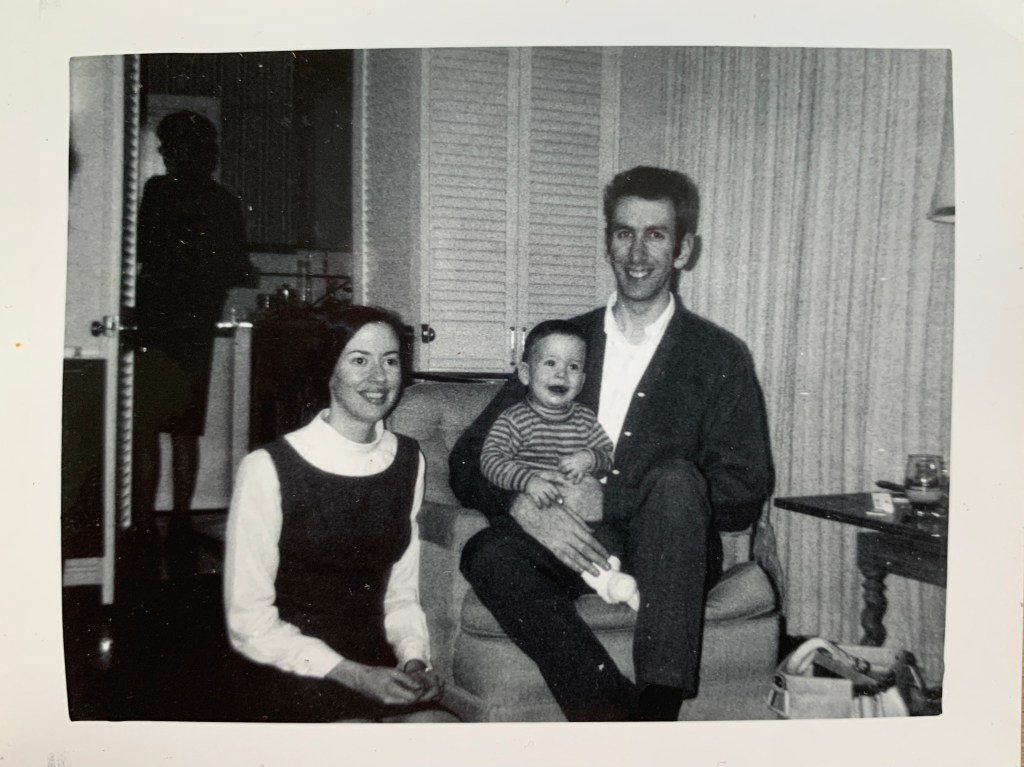
- “Unrememberable Yet Unforgettable”: Exactly How Life Works
My father’s hospital gown gaped over his broken back. He sat on the paper rolled out over the vinyl examining table, bent over and twisted at once, as if he was carrying an enormous burden on his shoulders and simultaneously turning away from a gale force wind. The gown’s fabric stretched and pulled underneath him; the ties in back were misaligned and impossible to close, leaving most of his back exposed, its awful, humped contour filling me with despair.
Just sitting unsupported caused my father nearly unbearable pain. Moving made it worse. As we waited for the doctor, my father looked miserable, drooping under how impossible life had become. This was his new reality, and it was awful. His slumped body showed signs of decline I had never seen before. It had been days since he had shaved or showered. There were layers of dandruff on the shoulders of the hoodie he hadn’t taken off for a week, and the skin on his neck was red, irritated and flaking. It was agonizing to dress and impossible for him to reach his shoes and socks to change them. He spent his time in a recliner that gave him a modicum of comfort, supporting his whole body, whether upright or prone. He could press one button to rise up to eat or watch TV and press another button to lay himself back down to sleep.
Since my mother’s hospitalization, the home aids had stopped coming. My mother had qualified for all manner of in-home help: a steady stream of bathing aids, housekeeping and cooking help, and wound care and infusion nurses gave my father some reason to get up every day. Volunteers from their synagogue delivered challah on Friday, and occasionally the neighbors came by to share a meal or to offer to rake the yard or shovel the walk. But all of that had stopped since my mother’s pneumonia landed her in the hospital. My father’s decline had been fast and unanticipated, so he wasn’t on the right lists to get help. My sister and I were dividing our time between our parents’ very different needs, and on this particular morning, I was the one taking my father to another orthopedist, recommended as someone who might make a difference where no one else could.
The doctor came in, introduced himself, and proceeded to ask all the same questions and get all the same answers that had stymied all the other doctors. My father’s vertebrae had begun to crumble and his spine was collapsing. Kyphoplasty, the surgical intervention indicated in such cases, had only resulted in more fractures. The doctor finished his questioning and told my father to stand up, offering his hands for support. At first, my father was at a loss about how to manage this–the doctor’s hands only offered a fraction of the requisite support—so he leaned his arms awkwardly on the doctor’s shoulders instead and managed to get to his feet. Once standing, he hunched and listed right. The doctor positioned a chair in front of him and helped him rest his hands on it, where his walker would normally be. Once he was sure my father wouldn’t topple over, the doctor walked around behind him. I watched the doctor trace the curved line of my father’s spine with his finger and place his hands on both my father’s hips and shoulders, seemingly to assess their alignment, but only revealing the lack of anything to align to.
In addition to the obvious structural issues, the skin on my father’s back was a mess. There were inflamed hair follicles, unidentifiable sores, irregular moles, and dry flaking patches. But the worst were the cysts. For at least the last few decades, my father’s back had been marked by inflamed cysts of some sort. They looked like blackheads that had grown to be domes the size of half a marble. Throughout my childhood, they were just the sort of thing that a kid finds gross about his father’s middle-aged body. My mother complained about them and my father ignored them. I wondered if they were a product of my father’s lackadaisical approach to personal hygiene, or if they could be hereditary. Would I be similarly afflicted in my middle age? I vaguely recall my father visiting the dermatologist and a benign or ambiguous diagnosis that inspired no change in the status quo. While gross to everyone else, my father could go about life unaffected by what literally happened behind his back. My mother’s irritation was rarely enough to cause him to change.
By the time I was at the doctor’s with him, my mother’s decline had preceded my father’s by a decade. A pain in her chest had been caused by a tumor in her chest. The tumor had mystified oncologists across the country, until most of them concluded that it was a lung cancer tumor, presenting on the exterior of her lung, pressing on her heart. The rare diagnosis hadn’t been caused by smoking, asbestos, pollutants, or toxic chemicals. Rather, my mother’s thymus had been irradiated during a brief period in the late 1940s when nuclear medicine was thought to be useful in the treatment of minor childhood ailments. Useless against childhood ailments, the irradiated tissue returned decades later in the form of a particularly aggressive cancer. More radiation treatment had saved her, but its side effects had confined her to a wheelchair. My father had been her caregiver for more than a decade. It was a selfless act. Among its many consequences, though, was that his own care had taken a backseat and his skin had gotten worse and worse. Now, the masses on his back looked like they contained half a golf ball. If middle age had been gross, old age was far worse.
Looking at my father’s back, this doctor, whose manner had initially been so confident and whose attitude bordered on arrogance, was stymied. I was positioned behind him and could see him sigh when he recognized that he had no answers. Some of his swagger disappeared with the realization of his helplessness. He wasn’t the first–every other doctor had reached the same conclusion. My father’s osteoporosis was extremely unusual–so sudden, and localized to his vertebrae alone. The damage was extensive and irreversible.
The doctor continued to examine my father, but he seemed a little lost, his gaze wandering aimlessly until the cysts on my father’s back caught his eye. My father’s dermatological issues had nothing whatsoever to do with the reason we were there, but the doctor found them irresistible. He pulled some purple rubber gloves out of the pocket of his white coat and put them on. He rubbed his finger back and forth over the biggest dome, cocking his head in curiosity. He gently pinched at one end of the dome and waited to see what happened. Receiving no response, either from my father or his skin, he squeezed harder, entirely absorbed now with this distraction. I wondered what he was thinking.
Then something happened that I still find impossible to believe. Without much effort, the blackhead on the dome opened up and a very smooth, dark shape began to emerge. The doctor kept his pressure constant and the hole grew bigger as the emerging shape grew wider. After a few seconds, whatever was coming out of my dad reached its widest point and then began to narrow again, as if it was the shape of a triangle or diamond, but maybe it was like an egg.
It was hard to tell what I was looking at. It was smooth and a little shiny, like a wet river rock, about an inch wide. As the doctor’s skillful hand extruded it, my father’s skin closed up again, until what had been inside him a moment before was now entirely outside of him. Finally, the doctor was left holding this thing. Its shape reminded me of a scarab from an Egyptian tomb. It’s texture was like a polished stone you might buy in a science museum gift shop or a craft store. It looked like it would feel good in your hand. I wondered if it was hard or soft, if it was heavy, or wet? What did it smell like? It was at once completely repulsive and utterly fascinating. I felt half like vomiting and half like asking the doctor if I could see it.
The doctor was oblivious to me, though, and held it up to look at it. He turned it over in his hand and cocked his head, examining it for a few more seconds before deciding he had seen enough. In one swift motion, he pulled off his glove, and with it, the thing he had held between his fingers disappeared into an inside-out glove that he tossed casually into the trash. It had been of no consequence to my father’s health, just a curiosity for the doctor. My father seemed oblivious to the whole thing. His skin had closed entirely, with only a tiny blackhead marking the spot where the thing had just emerged. The doctor dabbed the spot with an alcohol swab, but there was nothing there to dab. He took one last look and shrugged, and then he walked over to his desk to talk to my father.
I was speechless. Looking back, I think my jaw must have hung open in wonder. What the fuck was that? What had just come out of my father’s body? What had been living under my father’s skin? What part of my father was in a used latex glove in the garbage? Had I actually seen that?
I told myself, right then and there, that I had actually seen it. I told myself that there would be moments like this one–now, as I write this–when I would doubt what I had seen, think it impossible. But at that moment I promised never to let myself be convinced that it had just been my imagination. I had seen what I had seen. It had been real, even as it utterly defied reality, unlike anything I’ve seen before or since.
I know there are dermatology enthusiasts on YouTube and that a search for videos of cysts would probably show me a million possible skin conditions to explain it, but it’s one of those parts of the internet that I will avoid at all costs. This was my father’s dark, solid, smooth, intriguing, grotesque, unknowable thing. It was singular to him. There will never be another. I can make myself nauseous thinking of it, and I can wish I had it to run idly between my fingers. It seemed simultaneously demonic and also like it would be fun to fiddle with. For the doctor, maybe it was a way he could do some little good for an otherwise hopeless case. For me, it was one of those little moments in doctors’ offices with dying parents that sticks with you.
Like my mother’s tumor, mysterious and where no tumor should be, it was an uncanny reminder that the scariest things lurk within. They are unknowable and grotesque, but not without a dark allure. These masses don’t reveal their secrets; they remain unknowable to the end. They’re not onions to peel, nuts to crack, or eggs to hatch. They’re impenetrable, inaccessible, unknowable; dead letters, severed from origin and destination. They evoke primitive responses—gag reflexes and nausea—but inspire paradoxical feelings—a magnetism that makes it impossible to look away.
So why do I bring them up now? In the years since my parents’ deaths, I’ve been researching the dark legacies they carried in their minds and their bodies. I have written hundreds of pages, yet when I ask myself I’m really writing about, I struggle to articulate it. Every answer I come up with is wordy and cerebral, all head and no heart. While everyone talks about “intergenerational trauma,” the term rubs me the wrong way, both overly clinical and a bit melodramatic.
So, unsure how to think about what I’m writing about, I asked myself what image came to mind, I immediately thought of it–the thing that had come from inside my father’s back. So what am I writing about? I’m writing about a dark, impenetrable history, encapsulated by my parents’ psychic defenses and involuntarily bequeathed to their children. I’m writing about the unknowable things that lived inside my parents. I’m writing about the things that I saw and the things I didn’t see; things I wanted to possess and to run away from; things inexplicable and foreign, yet also strangely familiar and intimate.
I set out wanting to solve mysteries, to untangle the threads, to carbon date the samples. I intended to slice them onto slides and examine them under the microscope. But all that has proven impossible. In many ways, history remains a black hole, emitting no signal, swallowing all light that might illuminate it. My parents’ story offers only more riddles with no answer; masses so hard they can’t be penetrated, so smooth they can’t be gripped.
Psychoanalysts say that traumatic memories passed unconsciously between generations are “literally unrememberable yet truly unforgettable” (The Third Reich in the Unconscious p. 4) . Their experience treating intergenerational trauma reveals what is carried inside parents and then deposited in their children. These children arrive at their clinics haunted by their parents’ memories, without ever possessing the memories themselves. The story I’m left with is that of the historical burden–the malignant tumors and black masses–that my parents couldn’t metabolize and so left for the next generation, for their children, for me.
An inheritance like this is transformed when it passes from parents to children: what was unprocessed for the parent is unknowable for the child; what was red-hot for the parent is absolute zero in the child; the supernova that threatened to destroy the parent’s universe becomes a black hole, a gravitational pull the child might never escape.
Could this be why, for years, growing up in our household, I couldn’t shake the feeling that something was desperately wrong, even as nothing at all was desperately wrong? Could this be why I felt like something urgently needed to change, but nothing ever changed? What could have made me feel these things? Why did the appearance of fine feel like such a lie? What could possibly be so wrong?
When I looked around, everything looked just fine. Then why wasn’t I just fine, too? Why did I feel so fucked up? This is the question I’ve been trying to answer. My parents never knew it, but masses grew in them. Their bodies crumbled, breaking under the pressure of pasts they themselves didn’t understand.
My excavation can’t untangle lost history or recall memories taken to graves. The thing that was taken from my father’s back is gone. The memory of it remains as inexplicable as the thing itself. Yet it lives on, simultaneously as an abject totem of the decay eating away at us and as the object of a strange desire. It will always remain just out of reach, in forgotten dreams and in ghosts caught in sidelong glances. Whether as a totem and a dream, it can almost be dismissed–maybe I just imagined it, maybe it’s just the relic of an irrational superstition, or the artifact of a random hallucination? How could it possibly be more than that? But then again, how could subatomic particles in the 1940s kill my mother sixty five years later? How could my father’s back break after years of backbreaking caregiving, as if he was killed by nothing more than a cliché? It’s impossible, I tell myself. Life doesn’t work that way.
Yet what if that’s exactly how life works? What if the proof is in the everyday desperation, in the thing that feels so wrong, the thing that desperately needs to change, and the thing that’s killing you, or that you’ll kill for. What if it really is what you die from–or die without. Could this be what my parents’ generation died from and killed for, in the years of madness the split open the middle of the twentieth century? For what else can possibly explain this mad world? My parents were lucky and died of known medical conditions, well cared for, surrounded by families. But their cousins, their aunts, and their uncles died in gas chambers and bomb blasts, from gun fire, in warfare, suicide, and homicide. These deaths occurred in the earliest years of my parents’ lives. In fact, more of their family members lost their lives before my parents were six years old than in the rest of the 20th century combined. How could they remember them? How could they forget?
I grew up knowing only how they coped. Though they grew up in the safety of America, they’re survival wasn’t a given. They found their ways through difficult childhoods to live good lives, but their wellbeing felt precarious, their existence, anxious. It’s only in my generation that I can really explore the dark masses that pressed against my mother’s heart and weighed down my father’s back. This is the story only their child can write, the impossible history that they lived without knowing, that they survived and that killed them.
There’s an under-appreciated fluidity to memory: it flows from one person to another, across generations, in and out of awareness, its size and shape changing along the way, murky in the shadows. It can leave everyone wondering who exactly it belongs to. Like other fluids, memory can be dammed up, with pressure building, leaks springing, dykes plugged, and dams bursting. It can drown and flood, bathe and cool; it can infect and fester, wash and cleanse, nourish and kill. What’s deposited, expropriated, projected, stolen, rescued, hidden, or murdered is related to what flows and what’s stopped up.
My parents lived their lives well without ever breaking an unconscious conspiracy of silence, of forgetting, of avoiding. Perhaps they were able to live their lives well because they protected themselves with silence, with forgetting, and with avoiding. My own drive—my own way of living well and writing well–is to reveal. Thus my research project, which sets out to fill the absence of stories, the blanks in the diaries, the unmentionables in the ketubah, and the prunings from the family tree.
I’m writing this in the years immediately following my parents’ death. They still appear frequently in my dreams and I know that this project is energized by my mourning them. But perhaps it’s more than that, too. Perhaps I’m left mourning more than just them. What if there’s a backlog of mourning, a backlog of the deaths of two and three generations prior. These deaths are largely forgotten, occasionally remembered, sometimes erased. Regardless, they have never been properly laid to rest, never mourned. This means confronting history’s tragedies, while recognizing what’s at an impossible distance or in unbreakable code. It means accepting that some bodies are buried under tons of rubble or in unmarked graves, or incinerated in industrial ovens.
This project is one of liberating the stories of the ancestors and freeing the energy spent hiding from them for too long. So much of my sadness at the death of my parents isn’t about the lives they lost but about the lives they could never lead. They were never able to find the freedom to live the lives they wanted: their possible lives were boobytrapped by time bombs inside their bodies; their potential paths hidden away in boxes in the attic. If there were keys that might have freed them from their mental prisons, they could only be found in countries that had expelled them, behind iron curtains and enemy lines, and under cover-ups that hid unspeakable crimes.
All this, I’ve tried to find, even when it’s meant going against the grain of the lives of my parents and of other family members. I’ve sifted through the evidence that remains, to see what my generation can do that previous generations have been unable to, even when it risks disturbing the rest of the dead, giving them back their memories, their injuries, and their dreams.
 Jack-August