
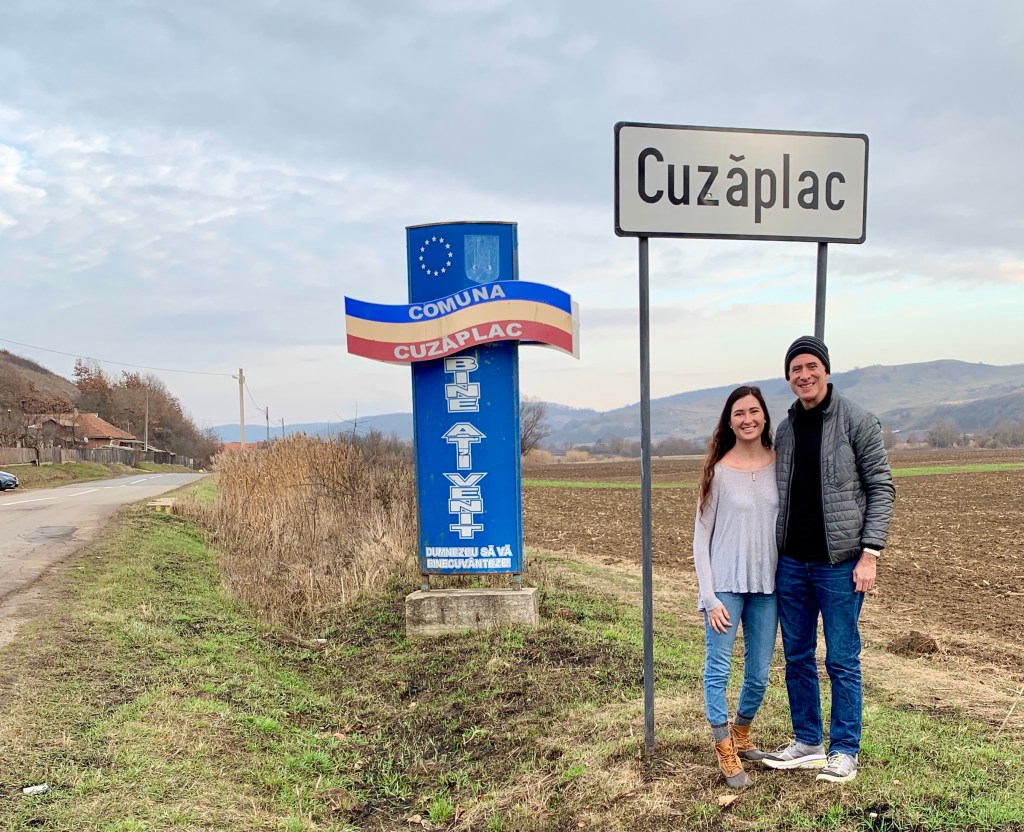
- Finding Középlak
I’ll never get to tell my father that I found that village where his father grew up. His father—Jack Marmorstein, my grandfather, my namesake—left there in 1920 and never looked back. Jack and his brothers and sisters never spoke of the place, leading their children to doubt its very existence.
“It was a tiny village,” my father told me, “bulldozed twice, once by the Nazis and again by the Soviets.”
Gone without a trace, like the Marmorstein family that had stayed there.
“Do you know what it was called?” I asked.
“Koo-Zee-Plak,” he said.
“Can you spell that?”
He just looked at me like he did whenever I asked a stupid question. He had told me everything he knew. He had never wondered where it was or how it was spelled. Growing up, there had been no traces of the old country in his home, no photos or keepsakes, and definitely no nostalgia. If there were memories, they were silent and went to the grave with my grandfather’s generation.
Koo-Zee-Plak… I wondered whether my father’s childhood ears had heard it correctly. His father had died in 1952. When was the last time he had even heard it? Did it begin with a K or a C? End with “plak,” or maybe a more familiar suffix like “platz”. These—and all other—questions didn’t interest him. For him, it was gone, the victim of history, like the family who had remained there.
My father’s low expectations—the ease with which he adapted to conditions around him, the way he didn’t hold on to what-if’s or could-have-been’s—had seen him through so much. No, my father didn’t compare himself to those around him; rather, he compared himself to the Koo-Zee-Plak of his imagination, to the very real ordeals of his father’s generation. He wasn’t being deported to forced labor or death camps; he wasn’t bulldozed by the Nazis or the Soviets; and he didn’t have to cross an ocean and start a new life from nothing thousands of miles from home. He knew he got pretty lucky.
[expand? adding more about Dad?]
II.
I inherited some of my father’s low expectations, and I hadn’t been very optimistic about my own search for Koo-Zee-Plak. Google wasn’t any help. Even if Koo-Zee-Plak was an accurate pronunciation of the village’s name during my grandfather’s childhood, my grandfather had grown up in Hungary and spoken Hungarian; today, the region is in Romania. Who could know what Koo-Zee-Plak would be in Romanian? Like my father, I prefer not getting my hopes up only to have them dashed. So for most of my life, I just imagined that he was right: Koo-Zee-Plak had been bulldozed twice. It was more folklore than reality, like so much of Eastern European Jewry.
But all that changed on a trip to Israel in 2016.
[add about Pip’s birthright, her being in the parking lot at Yad Vashem when their guide announced that Nazis were marching in Charlottesville, VA, in front of our family shul, the one she grew up in]
I took a bus from Jerusalem to Tzfat, an ancient town nestled in the mountains of Northern Israel, not far from the Sea of Galilee. For centuries, Tzfat has been a center of Jewish mysticism, a place where rabbis have authored some of Kabbalah’s great works and where seekers come to this day. In the sixteenth century, Rabbi Caro is said to have received the nightly counsel of an angel when he wrote his masterpiece of Jewish legal thinking, the Shulchan Aruch. Another legend tells of a pilgrim who made the long pilgrimage from Poland only to abandon Tzfat after his first night there, reporting the angels made so much noise at night that he would never be able to sleep so long as he stayed.
When I visit, my expectations are more modest: some peaceful mountain air, some art and music, and perhaps some funky Kabbalistic spiritual vibe. Music-wise, I’m lucky, I’ve inadvertently planned my travel there to coincide with the annual klezmer festival (no wonder our AirBnB is so expensive!). The sounds of soulful clarinets and spiritual niggunim fill the narrow alleys and float up to our terrace at all hours of the day and night. Klezmer’s characteristic Freygish scale can’t decide if it’s a major or minor key, playful or mournful. Perhaps this is what angels sound like.
The vibe is Santa Cruz meets orthodox Brooklyn, with audiences divided between the weed-and-hacky-sack spiritual seekers and the more traditional orthodox with tzitzit and single sex dancing. During my aimless wandering, I visit medieval synagogues where mystics prayed and I browse galleries full of oils by Russian emigres. Tzfat is famous for its candles—shops sell braided havdallah candles of all colors—and for its microcalligraphy—barely discernible text incorporated into larger images, so that the entire Torah might be written in a poster-size landscape of the Holy Land, or all the Psalms inscribed in the image of a prophet on a postcard. When I’m hungry, I’m told that Tzfat is also famous for its sheep’s milk cheese. There are mystic fortune tellers and Kabbalah workshops. There are trails that lead to caves where mystics once hid and now teenagers drink beer. All this makes for delightful exploration, and it’s exactly what I hoped for when I planned a few days in the quirky mountain town.
But then there is something that I didn’t expect at all: in front of a non-descript house, at the intersection of several small streets, there is a sign in three languages: המוזיאון למורשת היהדות הדוברת הונגרית. A magyar nyelvterületről származó zsidóság emlékmúzeuma. The Memorial Museum of Hungarian-Speaking Jewry. What? I’ve come looking for the mystical vibe and folk music, and here’s a museum that comes as close as anything I’ve ever seen to my own family’s heritage. I don’t even dare hope that they are open, let alone that I might learn anything. Low expectations.
It’s open. The museum is nothing more than a converted house with some bookshelves and a few display cases. There are no other visitors. We are greeted by a man who seems to be in charge. At the back of the house, in what appears to have been an old bathroom or small kitchen converted into the museum office, a woman sits at a desk in front of a twenty year old desktop computer.
“My family is from Hungary,” I tell the man after he greets us, knowing that I won’t be able to answer any of his follow-up questions.
“Do you know where?” The man asks.
“No.”
He looks disappointed. I feel like I should say something else, so as foolish as it seems, I continue.
“Maybe somewhere in Transylvania.” He still looks skeptical. “My father said the name of the village was ‘Koo-Zee-Plak.’”
“I’ve never heard of it,” he says, but I can tell he’s pleased.
“I might have misheard my dad. And he might have misheard his dad,” I add apologetically. Then I can’t help myself and I offer him a final out, my father’s out. “It was probably bulldozed twice, once by the Nazis and again by the Soviets.”
This won’t be the last time I find myself reading from my family’s script, but the museum director just shrugs it off. He walks straight to the woman in the back room. They speak quickly in Hebrew; their conversation ends with, “Koo-Zee-Plak?”
“Koo-Zee-Plak.”
I see her pull some books off her shelf and start looking through them. She’s on a mission.
The director takes us to another room, puts a videotape into a VCR, and plays an English language history of Hungarian Jewry for us. No one else is in the museum and we sit alone learning the basics of a world long gone, a world that my grandfather grew up in but that sounds to me as distant as that of the Romans or of the Pharaohs. When the video is over, the director reappears and announces that he had good news. He takes us back to the woman at the desk. She has xeroxed a single page from an old map and hands it to the director, who hands it to us. With the tip of his pen, he points to the name of a village. And there it is, in tiny eight-point type, on a map crowded with hundreds of other village names: Koo-Zee-Plak. Or, as it’s spelled in Hungarian, Középlak. Not even bulldozed once.
We scour the one-room library for any other reference to Középlak but find none. I don’t really recall the other three rooms of the museum. Whatever artifacts they hold can’t compare to a staff that can turn three nonsense syllables into a real place, a destination for the next time I’m in Eastern Europe. In this little house, they reconnected the past and the present. It’s a miraculous thread that I had assumed was gone.
III
[Find longer version with backstory… Beijing, daughter, etc… Introduce my life at this point?]
Without that thread, I wouldn’t be in Budapest three years later, renting a car to drive into Transylvania and find Középlak. When I tell Hungarians about my plans, they all warn me about driving in Romania, as if I will be crossing the border into some remote wasteland. At first, I ignore their caution, but the more people I talk to, and the more I hear the same warning, the more I think I might need a Land Rover or a Humvee to navigate the terrain. I even find a map store in Budapest and buy maps of the region in case I lose cell signal. At Avis in Budapest, I upgrade my rental car to all-wheel drive. The woman at the counter tells me about how 1990s Romania had a well-earned reputation for nearly impassable roads and lawless traffic. She says there’s nothing to worry about now, but adds a surcharge to my bill for driving in Romania.
The Hungarian name for Transylvania, Erdély, means forest, and it had once been part of Hungary. It was regarded both as a remote hinterland and also lost part of a greater Hungary that Hungarian nationalists mourn and a growing irredentist movement wants back. The hinterlands part seems right—on the map, the roads to Középlak are the thinnest of lines, full of switchbacks to climb and descend mountains and valleys. But a lot has changed: the roads have been paved and are well-maintained, some newer than those in Hungary. The border guards are gruff and almost deliberately inefficient, and the area near the border consists of worn and dirty industrial towns, but soon I’m on winding roads through old mountains. It reminds me of Appalachia, poor and remote, but beautiful. The only inconvenience is when I’m following trucks, some hauling oversized loads through narrow valleys and others that struggle to climb steep roads up mountains.
My destination is Cluj-Napoca, the biggest city near Középlak. In my grandfather’s time, Cluj-Napoca was called by its Hungarian name, Kolozsvár. Romanians renamed it Cluj-Napoca, but everyone just calls it Cluj. Romanians also renamed Középlak—it’s now Cuzăplac on maps of Romania—but it still sounds enough like its Hungarian form that the meaning is immediately clear to any Hungarian speaker. “Közép,” means middle or mid-point, and a “lak,” is a small village or hamlet. If the name is meant to suggest that it has some sort of centrality, it can only be ironic: Közeplak/Cuzăplac is remote to everything around it. If it’s in any middle, it’s the middle of nowhere.
About four hours after crossing the border into Romania, I finally reach Cluj. Rush hour traffic feels like a return to modernity after hundreds of kilometers through rural Transylvania. Cluj is a beautiful city, restored to much of its historic glory. It’s also thriving, with an excellent university and a bustling technology industry. My hotel overlooks a large square, bookended by a cathedral on one side and the opera house on the other, with a busy Christmas market in between. The square is bordered by beautifully restored baroque architecture. Colorful buildings are adorned with ornate domes, curved balconies, columns, and cupolas.
Prior to my travels, I searched social media and found a freelance graphic artist in Cluj with the same last name as me, Dan Marmorstein. I’ve been in touch with him and he’s agreed to help me out during my visit. As far as we can tell, we’re not immediately related. If a familial relationship exists, it would be four generations in the past and neither of us know of any records going back that far. Indeed, I seem to know more about my family history in the region than he does, even though he still lives where it all happened. With the upheaval of the last century, I wonder if adapting to the present is a better strategy than digging into the past. Perhaps it’s easier if some questions go unasked.
Dan has never heard of Középlak, either, though he’s lived his whole life within twenty-five miles of it. No one we ask has heard of it, either, but on our second day there, we set out to find it. Finding Középlak is no problem (we never lose cell service the whole time we’re in Romania and Google maps directs us without incident), but feeling a connection to it isn’t so easy. Középlak is tiny. We approach on a two lane road country road. At a certain point, the farm fields out the window end and are replaced by houses, built close together and set near the road. It’s indistinguishable from a dozen other villages we’ve driven through: run down and muddy, nondescript and dingy. The houses are surrounded by the detritus of country life—beat up old cars and farm implements, chickens and dogs, firewood and bales of hay. Some houses were once brightly colored—violet or turquoise or peach, with shutters painted in complimentary colors—but even these are dulled with dust and dirt. They’re not small; some look like they could house large families, or perhaps multiple generations. Most have satellite dishes mounted on the roof.
Középlak shows few signs of being bulldozed, but most of the houses are stucco, with some improvised from concrete block and wood. They’re not new, but they aren’t old, either; perhaps they replaced what had been bulldozed. Only two stone structures look like they survived the Twentieth century. One is in ruins, though the other looks occupied, surrounded by crafted iron fencing and with terra cotta shingles and a newer satellite dish than its neighbors.
In some of the other villages we’ve seen signs of life—elderly pedestrians, women in headscarves and men leading donkeys hitched to carts, but the streets of Középlak are abandoned when we drive through it. Even slowing to a crawl to take it all in, the drive from one end to the other takes only a minute or two. When we’re through it and back in farm fields, we turn around and drive back in the other direction. On the second pass, we notice the primary school, which shares a building with a community center and a library. There’s also a town hall, a yellow stucco cube that looks quite new, with a paved parking lot in front. There are Christmas lights hanging from the roofline and a sign identifying “Consiliul Local Commune Cuzăplac.”
It’s getting towards the end of the workday, but there are still a few cars in the parking lot. Dan is curious if they have any records of past residents, so we turn into the parking lot. My expectations are low. Even if the town hasn’t been bulldozed, how could any records survive two World Wars, a Cold War, a dictatorship, and a revolution? Those in power at any given time would have very little interest in maintaining records of those who preceded them.
The interior of the town hall is plain and functional, with a concrete floor and prefab walls. It’s chilly and drafty on this grey December day. It’s barely big enough for a few offices and maybe a small meeting room. A bulletin board near the door with various announcements is the only sign that you’ve entered a public space. We linger near the entrance for a minute or two before we hear any movement. Finally, two middle aged women approach.
Drop-ins and outsiders are probably rare and I detect slight curiosity behind the gruff facade of civil servants at the end of their day. I can’t understand them, but I can tell that Dan introduces himself and explains who I am. Among the unfamiliar words, I hear “Dan Marmorstein,” and “Jack Marmorstein,”and “America” and “Marmorstein?” and “Marmorstein.” Dan asks a series of questions. I can’t be sure, but I sense the atmosphere get chillier. The women cross their arms and confer with each other. Heads shake and lips purse. Finally, they’re giving Dan directions, pointing this way and that. Dan repeats what he hears and they respond with more instructions and hand gestures. Finally Dan thanks them and heads towards the door. I make gestures intended to express gratitude and farewell and follow Dan. I’m not sure, but I sense that they’re glad we’re leaving. When we get out the door, Dan is excited and relates what he heard.
“What did they say?” I ask.
“They don’t have anything here. No records of births, deaths, property. If anything exists, it’s in regional archives in Cluj.”
Low expectations.
“And no one remembers the Marmorstein family in the area. No one even remembers any Jews.”
There was a time when this would have been an obvious lie. But when these middle-aged women were born, there probably hadn’t been any Jews in the area for twenty-five or thirty years. If their parents had memories, they probably weren’t the sort you shared with your children.
“But they said one thing that is quite incredible,” Dan continues (he knows how to tell a story; he’s left the best for last). “When I introduced myself and told them your name, something strange happened. It’s like they heard something familiar, but they didn’t want to tell me. They looked at each other and one finally said that there’s an area nearby called, in Romanian, ‘of Marmorstein.’ It’s like in English if you said ‘Marmorsteinville’ or ‘Marmorsteinburg’. But when she told me that, the others looked at her and she shut up. I asked them where it was and they just gestured vaguely. I asked them why it was call “of Marmorstein,” and they said they didn’t know. They seemed nervous, like they were worried we might be here to take it back.”
Jews coming to reclaim their pre-War possessions. I heard stories and read books about this, but it was the farthest thing from my mind. Before Tzfat, I didn’t know that Középlak existed. Half an hour earlier, I had never been there. My reason for being here is curiosity, not acquisition. And what Dan just discovered is amazing: someplace nearby is still known by my grandfather’s name, by my name.
“One of the women lived there. In of-Marmorstein,” Dan continues. “She was about to tell me when the other women caught her eye and she stopped talking.”
Perhaps the women’s assumption that I was there to take something from them is rooted in anti-Semitic stereotypes or a guilty conscience. Or maybe that is just how you learn to think during decades of corrupt dictatorship and the uncertainty that followed. It doesn’t change the breathtaking fact that people live in an area that is named for my family.
After we leave the town hall, we look for more people to talk to, but don’t learn any more. The women had directed Dan to a few Jewish graves on a hillside in the next village up the road. We pull off onto a dirt road until we can’t drive any further, and then walk up a hillside and miraculously find three tombstones deep in the woods, each covered in at least half a century of foliage. As a cemetery, it’s tiny and lost to time, but still a remarkable trace of what was once here.
The sun sets early in December and we head back, first to Cluj, and the next day, back to Budapest and then back home. The trip has raised more questions than answers. The mystery of my Marmorstein ancestors is suddenly real. I promise myself I’ll return to Romania as soon as I can to learn more, but a little over three months later, Covid brings all the world’s travel plans to a screeching halt, and I begin my three year journey of solve the mystery of my Marmorstein family history behind my desk.
IV
My dad will never know any of it. I wish I could tell him, wish I could show him pictures and tell him stories. He’ll never know I found it, never know I returned. What I wouldn’t give to just ask him one more question, to just hear one more scrap of a memory, or just hear him say Koo-Zee-Plak again. He died in 2019, following a major stroke, on my fiftieth birthday.
The brutal reality of his death both fueled the pilgrimage and brought a lump to my throat each time I thought about it. The fitting Jewish gesture is to bring small rocks from special places to lay on the headstone of a loved one’s grave. When I traveled to Középlak, my father didn’t even have a headstone, as it hadn’t even been a year since he died, but I picked up some rocks anyway and finally laid them on his headstone a few years later, when I visited the cemetery on his 80th birthday.
But the farther I get on my research, the less I’m doing it for him. Rather, I’m doing it for my children and their children, for the other grandchildren and great-grandchildren of my grandfather’s eleven brothers and sisters. Their descendants are scattered around the world, but we all began here, in this Transylvanian village, in a place that still bears our name.
Many Marmorsteins didn’t make it far, only surviving a few days or weeks after they were taken from this place, murdered at Auschwitz or other camps. But others made it to America or Israel and lived long lives. But among their descendants, Koo-Zee-Plak is ever less real—a vague set of sounds, of unknown spelling or location, unloved and unmourned. My father had assumed it was dead and buried (twice). It wasn’t. I assumed it was lost to the oblivion of memory, but it remains, both real and a ghost. It’s both a home that we’ve left behind and an origin story that still haunts us.
Afterward
In his imaginary bulldozers, perhaps my father’s imagination was simply giving physical form to the emotional toll the Twentieth Century took on the Marmorstein sons and daughters of Középlak. Indeed, I’m still scouring archives and records to account for all my family from there. I don’t know if I’ll ever find everyone, but I know that I’m not the first to search. When I went to sign the guestbook at the Museum of Hungarian Jewry in Tsfat, I was curious who else visited a museum like that and paged through earlier entries. To my great surprise, I recognized a name: my second cousin—herself the daughter of an Auschwitz survivor, granddaughter of the Marmorstein whose land “Of Marmorstein” had been—had signed the guestbook just six months before. She had a reputation as the family historian, and if anyone would find this place before me, it would be her.
When I had planned my trip to Középlak, I reached out to her to learn what she knew about the family. But my emails to her went unanswered until I finally received a reply from her son. She had taken her own life a few months earlier. I barely knew her and am unfamiliar with the details of her life, but I was stunned. Thinking about it now, I can’t help feel that she had not only taken the role of family historian but also borne the burdens of that memory. [was this job more dangerous than I thought? Am I sure I want it? Is it too late to turn back?]. Perhaps my father’s impulse not to remember—his imaginary annihilation of Középlak, his refusal to look backward—contained more than just denial. Perhaps it contained wisdom, too. It can be too much, especially for his generation, the generation that barely escaped. Looking back is dangerous; my second cousin’s suicide brought that fact home. In his imagination, my father had kept the danger at bay with bulldozers. Only then could he bequeath to me a sense of safety and security adequate to the task of returning. The irony of my return is that it’s only possible because of my father’s determination to leave it behind.
 Jack-August