
“Karl’s Story, or, They Went to America”
What about Karl? The warm, charming man I remember isn’t in any of the family photos from before the War. He married Irmgard in 1948, three years after it ended. While the Boss family was in Memmingen, Karl’s Lierheimer family was about twenty miles away in Kempten. His father was a railway employee and his family kept bees and sold honey. I don’t know how he and Irmgard met, but I don’t see any mention of him in family letters until 1949.
There might not have been any photos in the attic of Karl from before the war, but there were plenty of photos of Karl from afterward. He loved photography and sent my grandfather a photo of himself and Irmgard to announce their engagement. When they had children, Karl sent lovely photos of himself and Irmgard with their daughters, first holding the adorable babies and then playing with laughing toddlers. I also have the photos of him that my mother took in Germany in 1965 and the slides that my mother and father took when they returned in 1968. I even have photos I took of him in 1987. In almost all of them, Karl is smiling brightly, often with his arm around Irmgard, even forty years into their marriage.


Karl and Irmgard in the photo that accompanied the announcement of their engagement, and with their first child
I can’t forget Martin’s words from 1990—“Karl was in the SS”—but reading the letters, seeing the photos, hearing the recollections of others, and remembering my time as his houseguest, I find nothing to make me rethink my impression of his warmth and decency.
I worry that I am easily fooled. In general, I’m more likely to empathize than to judge, more likely to listen with understanding than with suspicion. I’m painfully aware of history’s atrocities and humanity’s capacity for evil, yet I’m also inspired by humans’ capacity to heal and forgive. By the time I met Karl, World War II had been over forty years. By what authority would I stand in judgment over him? In what capacity would I condemn him?
But at the same time, I didn’t like the thought that I had been fooled. I didn’t want to think that I’d fallen for the same old lies that evil always told: “It wasn’t really like that,” “I wasn’t really involved,” “It was just what everyone was doing,” etc. By the time I met him in 1987—or even by the time my mother met him in 1965—Karl would have had decades to rehearse his story. The whitewashing of Nazi pasts began early and was nearly universal across German society. The postwar years began with the Allied denazification process, wherein Germans were classified by level of their involvement with the Third Reich. During this time, documents were destroyed, uniforms burned, pasts denied, cover stories created, and mutually exonerating testimony exchanged. It was Year Zero in Germany. The country lay in rubble, defeated, destroyed, and occupied. Over four million Germans were gone, and millions more wounded, crippled, or traumatized. Another ten million were displaced, wandering through the country in need of a new home. It was a time when so many were leaving their past behind and engaging in a little reinvention to face the future.
The topic of Germany’s reckoning with its past, including the Holocaust and its war crimes, has been taken up by hundreds of articles and books, and it’s far beyond the scope of my story. The important thing is this: by the time I wandered into my family’s little corner of this national drama, everyone’s story was well-rehearsed, and most everyone had figured out how to live with themselves and with others, even when it meant turning a blind eye to, or offering generic excuses, for the unspeakable horrors of those years.
* * *
If I still erred on the side of empathy and understanding, I wasn’t alone. If I was easily fooled, if I’m more likely to empathize than judge, more prone to understanding than suspicion, I came by it honestly. As I would soon learn, I was very much my father’s son.
I had always assumed that no one in my family had talked with Karl about the war. How would they? Why would they? I can imagine a million reasons why it would be easier to steer clear of talking about politics and the war, and I never heard anything about these conversations directly from my parents.
I might have gone on assuming no such conversations existed if I hadn’t googled my father’s name and found, in amongst random and relatively typical results, clear evidence to the contrary. It couldn’t have been more unexpected, yet here it was: a single email that my father had written in 1984 and that was preserved for posterity on an archived AT&T network.
(Yes, you read that right: my father worked for Bell Labs in the eighties and his posts to the nascent internet came up when I searched for him. This proves two things: what you write on the internet never goes away; and there’s never been an internet without debates about Nazis).
In it, my father relates conversations he had with Karl in 1968. It makes it clear that my father indeed knew that he was staying at the home of Nazis and that he did bring up history with his hosts, recalling it well enough to still be telling the story sixteen years later.
I always cringe when I read this email. I want to shake my father and ask, “Do you really believe that?” My father’s prose were never artful or subtle, but “lined up and shot”? My father’s blanket amnesty—“can not be faulted”—is as jarring as it is nonsensical. It wasn’t that my father’s moral compass was completely broken. I know, for example, that my father didn’t feel the same way about small towns in the American South during Jim Crow. Did he think that his wife’s family’s small town in the first region to support Hitler was really different? Small towns like this were replete with anti-Semiticism, including violent anti-Jewish riots, destroyed property, and laws excluding Jews from schools, work and civic life. The idea that you could witness years of Nazi rule, live in a hotbed of Nazi support, and invade four countries with the Nazi forces and somehow think that no one is much bothering about the Jews is crazy.
Search Result 5From: A. Marmorstein (amm@cbdkc1.UUCP)
Subject: re; the holocaust This is the only article in this thread
View: Original FormatNewsgroups: net.politics
Date: 1984-05-11 08:22:39 PST
[T]opics have come up recently on the holocaust that I’ll address in this…message…
I talked at length with some older Germans several years ago (one man had been in the lead battalion entering four countries and had been wounded four times by 1941). They told me about a jew who lived in their town who had won an important medal in WW I. All through WW II the Nazis left him alone, and the towns people saw him daily just like anyone else.
As for the other jews in town, “they moved to America”. I’m sure many did during the 1930s and therefore gave credence to that prevailing impression. I asked if any of these families in America ever wrote (since they had been neighbors and friends) and the people said no, but that is not unusual – how many of your ex-neighbors do you write to?
My conclusion is that if you (a jew or non-jew) lived in a big city and saw people lined up and shot then it doesn’t take much brains to know something bad is going on, but if you are one of the millions of germans living in ordinary towns who see some jews leaving for “america” and those that stay are left alone, then you can not be faulted for not sensing that a genocide is currently in progress.
Any research into Memmmingen’s history reveals that Karl’s portrait of the fate of Jews in Memmingen left out some critical elements. Indeed, a brief examination of Kristallnacht in Memmingen reveals the depth of the city’s anti-Semitism. As in the rest of Germany, residents of Memmingen engaged in anti-Semitic violence on the night of November 9, 1938, Kristallnacht, when Jewish businesses and homes were vandalized and synagogue destroyed. But in Memmingen, Kristallnacht was a particularly prolonged and well-planned affair: when burning the synagogue was deemed too dangerous to surrounding buildings, the civil authorities in Memmingen contracted with local construction firms to demolish it, a process that lasted several days and could not have been missed by townspeople. [ https://www.all-in.de/kempten/c-lokales/synagoge-wurde-abgebrochen_a222884 https://de.wikipedia.org/wiki/Synagoge_(Memmingen) ]. Indeed, it was a region with such ingrained anti-semitism that there were accusations of blood liable after the war–accusations so embarrassing to local officials that they tried to hide them, only to have US occupying forces insist that they prosecute the accuser.
Could there have been more room for plausible deniability in 1968? Could the fact that Karl was a soldier in combat be an acceptable alibi for his ignorance about what was going on at home? Perhaps my father imagined a blitzkrieg so overwhelming that four countries were invaded without much in the way of combat or atrocity, but everything we know points to the opposite conclusion. When the SS invaded a country, it was their job to instill terror in the population and to annihilate the resistance. It’s hardly plausible that Karl wasn’t part of this. Rather, his Iron Cross suggests he distinguished himself. But my father saw the fact that he’d invaded four countries as an indication of his expertise on the topic, not as an indication that he might have been among those committing atrocities.
* * *
I can’t know what it was like to live in towns in Bavaria during that time, and it’s likely it was easy to be in denial about the worst aspects of the Shoah. But even there, I recently heard evidence to the contrary. It came in the form of a family story intended to exonerate Karl’s father, who worked for the national railway. The story is that Karl’s father called in sick to his job at the train station when he knew that trains full of Jewish deportees were coming through town. While showing a minimal capacity to recognize evil and decline to participate in it, his father’s memory makes Karl’s “they just went to America” claim even more risible.
There’s only one conclusion: they might not have known all the details, but they knew damned well what was happening to the Jews. Perhaps Karl had repeated those lies often enough that they felt like the truth, but he has to know he’s lying to my father. As with all lies we tell, I’m sure he had his reasons. I’m sure he imagined that an American Jew in 1968 couldn’t possibly understand what it was like in Nazi Germany. I’m sure he told himself that lying was a reasonable thing to do. Perhaps it even suggests an effort to keep the piece, but it could also suggest the opposite: maybe he was an unrepentant and unapologetic Nazi.
* * *
There are things I’ll never know about Karl’s life and psychology. I only saw him for a week or two of my life. But what does the story say about my father’s—and possibly my—outlook on life? My father couldn’t have known anything about the region’s anti-Semitism, Kristallnacht or the trains. He applied some clumsy stereotypes of rural life to what Karl told him and wrote about them in an email that minimizes the culpability of the family he had married into.
In his email, It’s as if my father is shrugging at life’s darkness and saying, “Nu? What did you expect?” These are the low expectations that protected him from disappointment, but they also meant he let the world off the hook. For a man who ended up with the short straw all too often, my father could be very forgiving. Perhaps forgiving is preferable to resentful, but some part of him may have also learned that it was better to placate the bully than confront him.
Regardless, my father wrote the Nazi’s alibis for them. In context, I understand how it would happen. My father was talking with his new wife’s family, a family that by all appearances was welcoming him with open arms. It must have taken courage to ask questions about the Jews in the first place (I did no such thing when I visited nineteen years later). Just a few months before being in Memmingen, he had stayed with his Auschwitz-surviving first cousins in Israel. They must have been on his mind when he asked. Yet after having the courage to bring up the topic, my father accepted the usual cover story. Perhaps my father only wanted to hear what the average German might respond to the question, but if he had doubted their story, why was he repeating what they told him decades later. Was he simply gullible? Was he easily fooled, his forgiveness too easily given? Did he pass this trait on to me?
But I’m attracted to another way of understanding my father’s acceptance of Karl’s view that the Jews had “moved to America”? While a lame and implausible excuse, my father’s key question says something important about his–and my–mindset: “I asked if any of these families in America every wrote and [they] said no, but that is not unusual–how many of your ex-neighbors do you write to?” My father’s first impulse isn’t to blame, but rather to reflect on his own behavior. His rhetorical question brings attention to the exact point where mundane human behavior (not keeping in touch with former neighbors) becomes both an alibi for—and an enabler of—terrible evil.
My father’s observation is about normal human behavior, but it’s also vast in what it suggests about the moral consequences of that behavior. If our feelings for our neighbors disappear the moment they become ex-neighbors, then a genocide can easily happen without us noticing, just as long as it’s at a small remove.
My father is more interested in understanding the complexity of responsibility than he is in simply condemning an individual’s behavior. Thus he doesn’t accuse the wartime Germans of not keeping track of their former neighbors. Rather, he asks how many of us write to our ex-neighbors. His questioning is rooted in his empathy and an awareness of his own fallibility. It’s as if he’s always asking himself: could he have done the same thing? The answer, he concludes, is yes, of course he could have.
Indeed, this is how I prefer to frame my father’s email: it’s not so much that he’s gullible and eager to let post war Germans off-the-hook. Rather, my father sees little use in blame and prefers instead to learn from what he hears. For my father, it would be dishonest to condemn Nazis without reflecting on our own behavior. How can we sit in judgment over an other without imagining our own vulnerability to committing the same evils?
What about the responsibility we show to each other, to our neighbors, and more importantly to those we can’t see—to former neighbors or those who could have been neighbors, but for wars and prejudice and laws and borders. We can always claim to have no influence over such things, but if we use that as an excuse, are we much better than Karl?
We might absolve others (like wartime Germans)–and ourselves–of responsibility for what we can’t control, but what if we should be drawing the opposite conclusion: the more we can’t control, the more responsible we need to be. It’s in the darkness, where we can’t see, that we need to be the most vigilant. My father seems to be reminding us that the worst inhumanities happen out of sight, where we won’t notice unless we amplify the scope of our responsibility and understand that being a good neighbor means staying a good neighbor when our neighbor is out-of-site and might otherwise be forgotten?
* * *
While I related to my father’s intellectual and moral inquiry, I’m still not letting Karl off the hook. You might not write letters to your neighbors when they move away, but you are aware when a years-long campaign of hatred drives them from their homes. Karl’s story that the Jews left for America was rooted in the unspoken awareness that Germany had descended into an environment of such overt and cruel anti-semitism that any reasonable Jew would certainly leave (except the decorated hero of the first world war, who had faith that he’d go unmolested, and we saw how that worked out in the case of Lajos Marmorstein).
The Nazis knew that the first step in murdering the neighbors of millions of Germans meant moving them, so they no longer have neighbors to care about them. Thus, exclusion from civil life preceded ghettoization, and ghettoization preceded deportation, and deportation preceded murder. By the time they’re murdered, they’re far from their neighbors and easily forgotten. My father could have told you why this works, and I think he would also tell you that holding Karl–or any other individual–responsible for a mass phenomenon wouldn’t make a bit of difference.

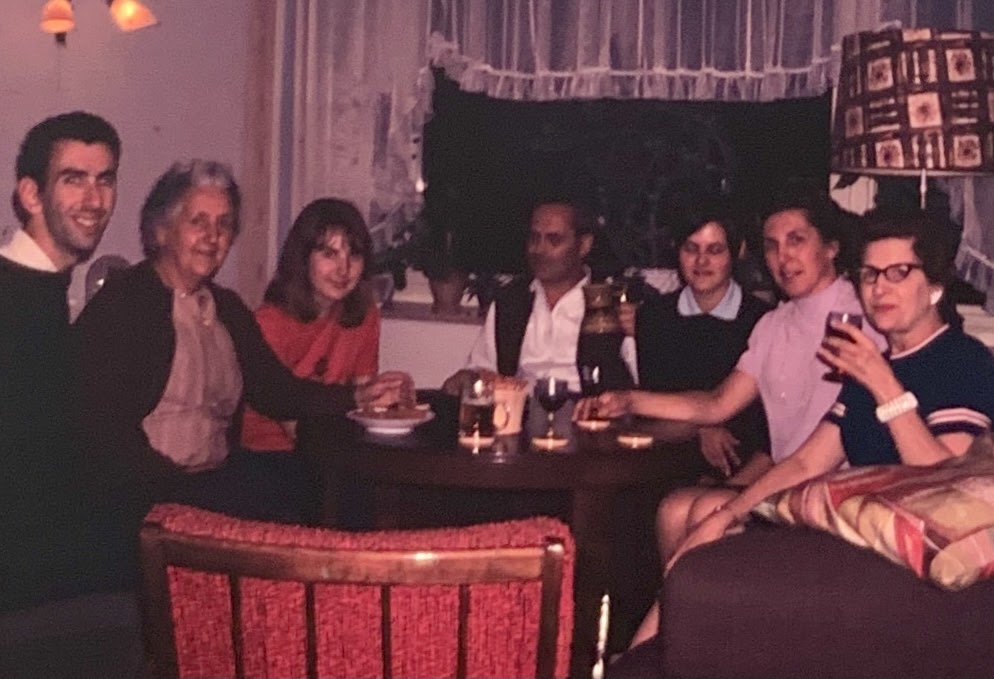
My father, far left, next to Tante Clär, with the German Boss family in 1968. Karl is seated in the middle
 Jack-August