About a third of Pompeii has yet to be excavated; the consensus among scholars is that this remainder should be left for future archeologists, and their presumably more sophisticated technologies.
–Rebecca Mead, “Pompeii Still Has Buried Secrets” 11/22/21 New Yorker
https://www.newyorker.com/magazine/2021/11/29/pompeii-still-has-buried-secrets
- Picking through the Wreckage
When I used to think about the treasures hidden away in the attic, the ancient artifacts in the Higbee’s box were what came to mind. When I was very young, the box had taunted me from the highest shelf in a basement cabinet, far above my reach. I would stare at it and anticipate the day that my parents would take it down and show it to me again. It was hard to resist the urge to ask, but I worried that asking for something I wanted so much might jinx it. I couldn’t understand how they ignored something so special for so long, but there seemed to be an implicit rule that items so precious and delicate needed to be preserved–untouched, undisturbed. They were so rarely seen, but occupied a revered place in our imagination. At some point, probably about forty years ago, the box disappeared into the attic and my parents stopped showing it to me at all.
Now the box is mine, yet with unfettered access to it, yet I remain hesitant to open it. I’ve looked through it a couple of times, but I am still scared that handling these artifacts will do some irrevocable damage or spoil them forever. Even the thought of touching them makes me worry that some surface might flake off or that edges might crumble. I still avoid it, as if, after two thousand years, one more glance could turn it all to dust.
Unlike other boxes in the attic–those full of letters and photos; newspaper clippings and documents–this box of shattered pottery, cut bits of stone, shards of glass, and clumps of oxidized metal doesn’t reveal its stories easily. I can question old relatives about the letters or identify the face in a portrait, and I have placed all manner of family truths where they belong, but the artifacts in the Higbees box remain orphans. The rubble in the boxes, ripped from its context and without provenance, resists all inquiry; other artifacts speak; these are mute.
Here’s what I know: As young newlyweds, my parents lived in Israel. My father was just out of the Air Force and my mother had converted to Judaism prior to their marriage. It was my father’s first time out of the country, and it was a chance for my mother to immerse herself in her new Jewish identity. They studied Hebrew at Ulpan, and, to a degree that I only realized decades later, considered staying. If they had, I would have been born there, raised the child of immigrants in Israel as they had both been raised by immigrants in Ohio.
Their timing was good. It was 1967 and the Six Day War had just ended. When they arrived, they found windows criss-crossed with tape, in preparation for combat that never came. Instead the Six Day War was over almost before it began, with the coalition of Arab states in shambles and Israel jubilant. Following a military victory that exceeded anyone’s expectations, Israel was on a national high. Syria no longer held the strategic Golan Heights and Egypt was pushed back to the Suez Canal, but neither of those mattered compared to the symbolic enormity of a united Jerusalem. With the Old City no longer controlled by the Jordanian army, Jews praying at the Western Wall of the Temple Mount stood on Jewish territory for the first time since the destruction of the second Temple, nearly two thousand years before.
At Ulpan, my parents befriended an American archeologist and caught his enthusiasm for the new era for Israeli archeology. Overnight, Israeli archeologists had gained access to all the territory that Israel had captured in the Six Day War, not just the Old City of Jerusalem, but also Biblical cities like Hebron, Jericho, and Bethlehem. So it was that my parents tagged along with an American archeologist, himself following Israeli archeologists to see what he could of the new excavations. These trips to archeological sites thrilled my parents. They talked about them for decades afterward. I can’t think of any memories that made them happier.
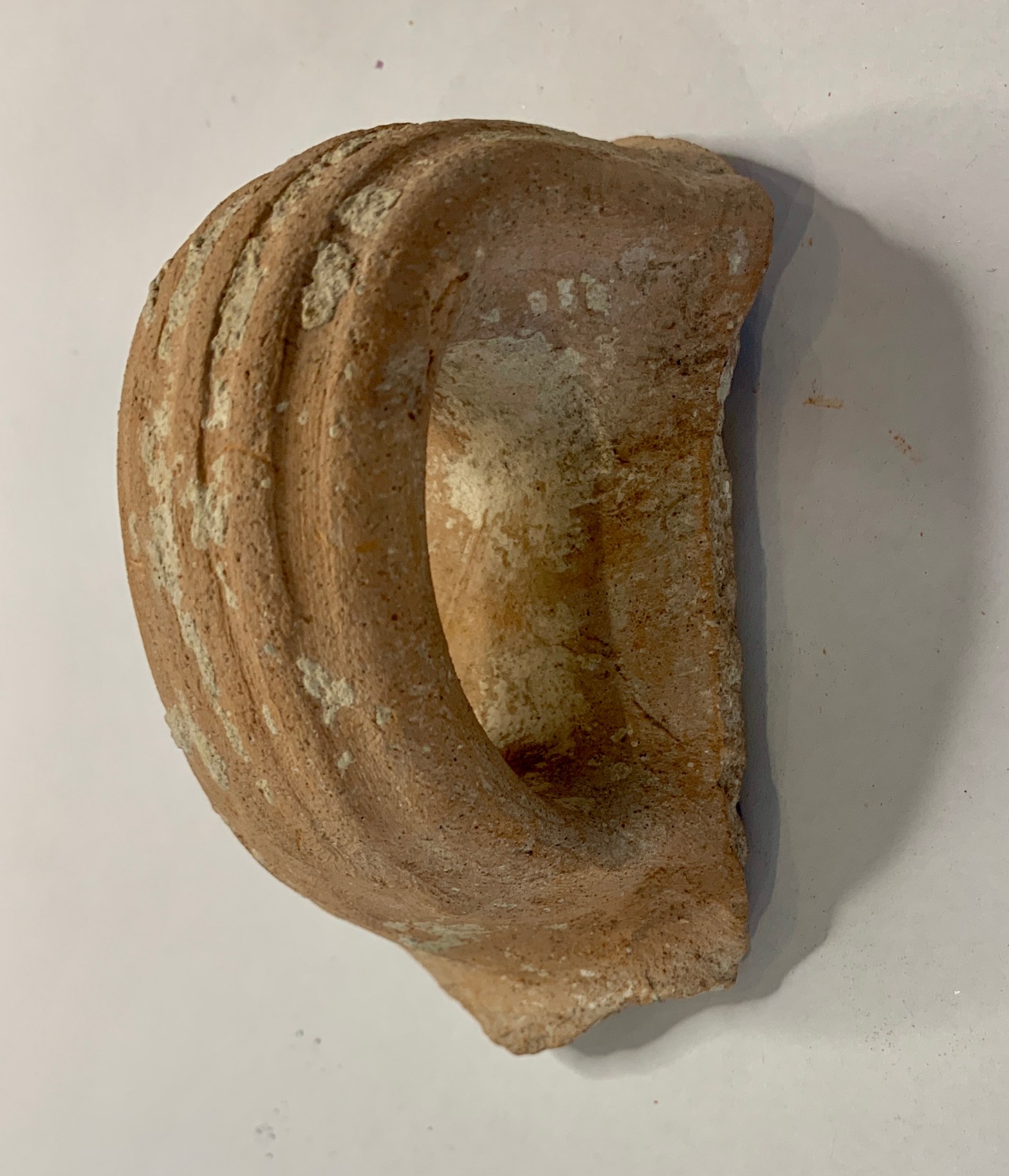
The Higbees box held the traces of these trips: the detritus of these digs: fragments of pottery, slivers of glass, nuggets of oxidized metal, and small cubes of stone. These last–fragments of mosaics–were the object of my mother’s greatest reverence. She was awed by the patience, artistry, and craftsmanship that it must have taken to form stone into dazzling images, and she was thrilled to possess some little piece of this artistry, as if each stone represented a brushstroke in a Van Gogh painting or a single note of a lost Beethoven symphony. She was untroubled by the fact that her possession meant the painting or the symphony was lost forever.
I once showed the box of artifacts to an archeologist who specialized in that era of Jewish history. The box upset him: to an archeologist, any artifact ripped from its context lost all of its potential meaning. Without provenance, they were worse than useless–they were an insult to history. It didn’t matter to him that they had been discarded by archeologists in 1967. Their presence in a box in North America represented an irredeemable loss, an offense to the archeology itself. No matter that my parents were collecting refuse, they shouldn’t have. His scorn stung, and I haven’t asked for a second opinion. The artifacts objects in their current form may void all their historical significance, they may still speak a deeper truth: maybe not about Biblical Israel but about wreckage that can’t be repaired, a lost whole that can’t be put back together.
My parents weren’t looters or thieves of archeological treasures. They were careful to respect the authority of the archeologists and triple checked before they went anywhere or touched anything. Yet at every site, there were heaps full of artifacts the archeologists had designated as trash, having decided that they have neither current significance nor any hope of being decoded in the future. Those cubes of mosaics? The fruits of my parents’ archeology site dumpster diving. Discarded into a literal trash heap of history, these orphaned fragments of ancient Israelite history accompanied my parents back to Ohio and spent the next fifty years in their attic. Like butterflies under glass or keys to a long gone home, they raise the question of whether they’re treasured possessions or symbols of irreparable loss.
[transition]
The archeologists of Pompeii have left a third of the site excavated, so that future generations, with both more sophisticated methods and new ways of thinking, can make discoveries in their own fashion. Taking the long view is impressive; in 1967, Israeli archeologists were in a mad rush, thrilled by access to sites they never dreamt they would see. Not only were they driven by intellectual curiosity and a thirst for knowledge, but they were also heroes in a national narrative, one of legitimizing a homeland by recovering its past buried under the wreckage of two thousand years of invasion, plunder, colonialism, and occupation. Presenting two thousand year old evidence in support of a twentieth century nationalist movement may be anachronistic, but for a people without a homeland for millennia, to be able to dig into your own dirt, and find evidence of your own history, is thrilling. Beyond what you uncover about the past, the act itself confirms the miracle of your own existence in the present. If the persistence of a people for thousands of years is remarkable in the abstract, reaching across time and touching the proof of that continuity is even more so.
I can only imagine standing on a piece of land where you would have been killed for standing just months before, digging your hands into the earth, and holding evidence of your forebearers. It had to represent more than the thrill of discovery; perhaps it felt like a wormhole that passed through the previous millennia as if they hadn’t happened. The millenia had been a journey out-and-back, a long journey home. Israel promised the right of return to the world’s Jews, a lifeline to protect against all future hazards.
- Too Late, or Just Beginning?
Yet as a protection against the threats Jews faced in the diaspora, Israel had come ten years too late. When my parents were in Israel, the holocaust was the unspoken tragedy under everything else, only buried under the surface by the need to deny it in order to live. Scratch Israel’s skin and it bled the holocaust. The idea that archeologists could tunnel their way back to a Jewish home untroubled by the intervening catastrophes met the desperate need for denial. Tunneling back to the Second Temple Era Jewish Kingdom represented a tunnel between the beginning and end of the Diaspora, as if the intervening millenia could be erased from history. In the Zionist narrative, the Holocaust had been the final nail in the coffin of a two thousand year old experiment of living in diaspora. The findings were clear: Jews were not welcomed in the land of the other; instead, they were defenseless, victims. Ending up stateless refugees after World War II was only fitting–they had been essentially stateless for millennia. No, the Zionists had been proven right in the most tragic possible way: Jews were only safe among their own, in their own homeland.
If only the early Zionists had prevailed a decade sooner, the world’s Jews would have had a refuge from catastrophe, a place to escape to and where they could have had agency for their fate. But Israel hadn’t existed at Jewry’s moment of greatest distress. Even as the new state presented itself as a Phoenix rising from the ashes, a dark voice whispered that Israel was too little, too late, little more than blood money paid by postwar Europe to the people it had just eradicated.
In Israel’s early years, its citizens were too busy building a new state to obsess over such things; now, they are fading in the rearview mirror. Israel’s existence in one of the world’s most unstable regions is never easy, and world Jewry is never untroubled, but the darkest days of the twentieth century feel like a long time ago. But in the scope of Jewish history, though, they’re not. Catastrophes don’t resolve themselves in eighty years, in three generations. The only precedents in Jewish history–the destruction of the Second Temple and the expulsion from Spain–changed everything. The ultimate meaning of these catastrophes wasn’t clear for hundreds of years; do we think we can leave the holocaust behind just as we’re about to bury the last survivor?
What we know as Judaism today didn’t exist until the Second Temple was destroyed; and most forms of Jewish spiritual life today emerged in response to the catastrophe of the expulsion of Jews from Spain and the Spanish Inquisition. We can only make sense of these revolutions centuries after the fact. At the time, events must have been a chaotic blur–realities that had come to be over centuries were destroyed in a matter of days or weeks–but in retrospect, the current of history moves more slowly, on the scale of centuries. Today, only eighty years since the holocaust, and we’ve only just begun. We’re in the middle of something, and none of us will know how this revolution ends. In the big picture, we’re still sifting through the ashes; we’ve only just begun to clean up the rubble.
From the midst of our short lives, in the context of one urgent crisis after another, it’s easy to lose track of this larger context. Sometimes it seems like we should get over it already. At moments like that I imagine telling the Rabbi Akiva–a giant among the early rabbis; one of the greatest authorities of the Talmudic era–that, seventy-five years after the destruction of the Temple, it was time to move on. At that time, no one would have had the slightest notion of the Talmud or Rabbinic Judaism. Eighty years after the expulsion from Spain, Isaac Luria hadn’t even arrived in Tzvat, the town in Northern Israel that hundreds of years later would be synonymous with his revolutionary mysticism. The holocaust has already changed almost everything about world Jewry, but the revolution has only just begun.
I only began to look at this larger context recently. For much of my life, I’ve assumed that I’m too late–too late on the scene, too late to offer much. Maybe everything has been said already; everyone who wants to tell their story already has. I always wanted to know the family stories, but as early as the 1980s it seemed too late. The uncles and aunts were so old already, their accents so thick, their memories so faded. How would I even ask? In subsequent decades, more family died. I couldn’t even keep track. I had replaced my curiosity with clumsy denials–there was nothing there to learn anyway; no one else seemed interested for the obvious reason that there was nothing there to be interested in.
[abrupt transition; smooth out]
Finally, a few years ago, my parents died and I had access to the archeology sites of my own history. Like those archeologists digging into the ground in Israel, I finally had access to the boxes in my attic, but only because it was already too late: my parents were gone. No sorting through the unknown truths of their lives would bring them back.
But what’s it too late for? To bring back the dead? Yes, of course it is. To stop the flow of time or to defeat mortality? Too late for that, too. To put mosaics back together or rebuild the Temple or restore the kingdom of King David? But what if we’re deluding ourselves, thinking that there’s an original to recover? To answer these questions, it’s worth going back in time and looking at how Lurianic Kabbalah eventually made meaning of the massive dislocation of the fifteenth century. For Luria and his followers, creation itself was a dislocation, an exile. When the universe was God, and God was everything, there was no room for creation, for anything that was not-God; in other words, there was no room for us. So, creation occurred when God receded, contracting the sacred to make room for the profane, wrenching apart the earthly from the godly. Luria called this receding tzim tzum.
In Luria’s creation story, God’s light can’t be everywhere, but it also can’t be held in the vessels intended to contain it. The vessels shatter, and the sparks of God’s light are scattered through the human realm in the form of shards from the shattered vessels. The task of humanity then becomes the ingathering of these sparks and their return to their home in the sacred, accomplished through the mitzvot, through Jewish law and practice. This is known as Tikkun Olam, repairing the world.
Critical to this metaphysical flow of history is that humans are not rebuilding the vessels. By shattering the originals, rendering their restoration impossible, Luria’s cosmology offers space for creative engagement with the sacred and creative renewal in each generation. The sparks can be found in the here-and-now, and they can be engaged in the living, breathing flow of Jewish practice. Repairing the world isn’t detective work to recreate a prelapsarian origin; rather, it’s the creative liberation of the godliness that’s hidden in everything. It’s not a loss to be mourned, but nor is it easy. Like the generations that followed the Second Temple and the Alhambra Decree, we live in the midst of catastrophe. As Faulkner wrote, “The past is never dead. It’s not even past.”
The feeling is one of everything being shattered, impossibly divided and impossible to contain. This is the feeling of walking through the wreckage, of stumbling and trying to balance on unstable rubble. It’s nearly impossible to see the big picture in times like this. All we can feel is our own helplessness. Catastrophes pile on catastrophe. We obsess about forgetting, because who can even remember the holocaust (and Hiroshima, if you want to universalize humanity’s existential crisis) when there every year brings new wars and genocides, political movements, reactionary violence, and climate disasters, not to mention banking meltdowns, refugees crises, and a pandemic? This is what post-trauma looks like. This is a nearly universalized experience that follows a century when hundreds of million people lost their lives to political violence.
[Transition?]
When I dig through the wreckage in my parents’ attic, I find more than the Higbees box of Second Temple era artifacts. I discover the rubble of my family’s past. I find the archeological artifacts of the horrors of the 20th century, and the shattered fragments of my family’s experience of it. It’s all ripped from context: thousands of miles from their origin; a generation or two out of context; and mixed and matched with artifacts I’ve found in online archives and via digitized ink and paper decades (or centuries) old. What does the origin mean at moments like this? What is an objects’ provenance, its proper place? The truths of my family live on in family members in Philadelphia and Cleveland; Israel and Germany; Miami and Los Angeles. The ancestors–their remains in Germany, Ukraine, Poland, America and Israel–haunt and inspire; their memories are denied or embraced, transformed or preserved; in these words and elsewhere. This project isn’t to enshrine the past or entomb the dead, but to pass the data forward, so the future can work with it, and it can be part of the journey, wherever the meaning and impact of the catastrophes and miracles of the 20th century finally ends up.
- Memoir of the Future
Like many children of boomers, my sister and I faced the formidable challenge of cleaning and selling our parents’ house. My parents hoarding had been unchecked for decades and had taken over most of the rooms in their suburban colonial. My mother had been in a wheelchair for the final fifteen years of her life, so they lived exclusively on the ground floor. The four bedrooms served as storage: my mother’s complex medical situation meant that one entire bedroom functioned as a medical supply store room. Other rooms were full of spare parts, extra furniture, old clothes, and purchases that were often never even opened. My father had a basement and workshop full of tools, ranging from the practical to things like power tools to the worse-than-useless: leftover battery acid, used oil, and a drawer full of twist ties and rubber bands. My mother had collecting tendencies and there were hundreds of Beanie Babies filling several large plastic containers, as well as her first dental hygiene tools, dating back to the 60s.

When I was fed-up with the clutter, I sometimes sketched before I cleaned
The task of cleaning all this alternately filled me with fascination and rage. This was my dig, my archeology. Now I was the one on my hands and knees, in a mask to protect from decades of dust, mildew and mold, separating trash from treasure, that which is full of meaning and that which is devoid of meaning. My parents had guarded their clutter fiercely, and had been suspicious of any snooping or surreptitious decluttering. I could finally access it all, without limits, without judgment, without sneaking behind backs or dissimulating motives. And the plunder was all ours. Nothing was off limits: the proscribed treasures; the toys saved for grandchildren then deemed too fragile for them to play with; the boxes sealed shut; the gifts purchased but never given, it was all ours now. So much of our past had never seen the light of day.
I grew quite accustomed to the crazy things that my parents held on to: things like boxes of cardboard toilet paper rolls, empty bottles that were once filled with cleaning supplies, clothes that no one had worn since the 1980s, electric blankets with bare wires sticking out of them. These quickly filled four dumpsters, but there were also treasures: this is where I found the Higbees box of archeological artifacts, and so much more. I liberated the slides and the boxes of family letters and artifacts that have revealed my family’s stories to me. I unearthed all the stories that my parents had buried during their lifetimes. I could finally investigate all this freely, without fear of my parents’ judgment or defensiveness, but that meant that I would be investigating alone. I would never talk with my parents about what I discovered. My questions for them would remain forever unanswered, my assumptions and hypotheses about them, forever unconfirmed.
Yet maybe no one wanted to talk about it? Had it been buried for a reason? What if the things I’ve uncovered, no one wants? Was our family predicated on some measure of plausible deniability? Was the truth intolerable? Was it noxious to our sensibility? Toxic to the life my parents built?
My parents lived out their negotiation of the complexities of a Jewish and non-Jewish family in relative peace; they were more concerned with building something for the future than looking back on the past. Their marriage wasn’t an easy one–it fell short in the million normal ways that marriages are hard–but no one would have said that their marriage was more impossible than most. Theirs was an intermarriage typical of mid-century America, not a Capulet-Montague affair that would end in death, or a Loving v. Virginia issue that could only be adjudicated by the Supreme Court. Nor is it the case that my sister and I are the product of some historical impossibility that could only survive under conditions of the complete denial of history. We experienced our identity as no more complicated than millions of others. We were a minority in a pretty homogenous midwestern city, but mostly we thrived. Even though my mother had converted just two years before my birth, we were the offspring of two Jewish parents, and we were raised unequivocally Jewish.
There may have been more in my parents’ immigrant pasts, but they didn’t talk about it. Both of their childhoods had been marked by the early loss of their fathers. Even under the best of circumstances, my parents weren’t storytellers, and I always had a sense that most memories of childhood were too painful. I was named for my grandfathers, Jack for my father’s dad; August for my mother’s. But they had died decades before my birth, and I was a teenager before I had seen pictures of either man.
For my parents, I think that the deaths of their fathers in the early 1950s, obscured a deeper layer of history. Both of my parents were born in America, just months before Pearl Harbor. But for the families that their immigrant fathers had left behind in Europe, the war was already raging. Overseas, my parents’ families fought for their lives. Like many American Jews, I learned about the holocaust in the abstract, but it remained mostly unspoken in my family. I had been at many family events with my father’s cousins who had survived Auschwitz, and was aware that there were other survivors in Israel, and other aunts, uncles, and cousins who hadn’t survived, but I knew nothing more about it.
The survivors had brought nothing, so there was no trace of my father’s family’s history in the attic. I’ve had to depend on archives and historians to learn more about their fates. But my mother’s family was another story: my grandfather had left the rest of his family in Bavaria, and their experience was thoroughly documented in the boxes full of letters and photos that they had sent my grandfather. And what they documented was this: they were Germans, not Jewish. They were Nazis–SA Brownshirts, Wehrmacht soldiers, SS members. They fought in Poland, France, Belgium, and the Soviet Union. And they were decimated by the war: some were killed in combat; others in Allied bombings. In 1938, my grandfather’s close family–siblings, parents, nieces and nephews–numbered eleven; In 1945, there were four. [too fast a reveal? slow down]
I’ve spent the years since I cleaned the attic doing more research on both sides of my family. The digging is just about done. I haven’t just cleaned out the attic. I’ve searched online archives, traveled across the world to ancestral villages, and researched in four languages and on three continents. I’ve deepened my relationship with both sides of my family. I’ve connected with members of my generation as well as the older generations, and I’ve collected memories, information and backstories–all pieces of a sprawling puzzle.
In the postwar years, both families evidenced the telltale signs of trauma: splits and conflicts that tore apart the survivors; premature deaths from health problems; suicides and violent crime; and the burden of unspoken truths, incomplete mourning, and unhealed wounds. After several generations, family members have scattered far and wide: members of my Bavarian family live in South Africa, Majorca, and the former East Germany; members of my Jewish family live in Israel and in all corners of the US (and a few in Japan and Ireland). It’s been a pleasure reconnecting with some and meeting many others for the first time, and my curiosity has generally been met with generosity, though a surprising number of people seem hesitant and an unexpectedly high percentage of emails and calls go unanswered.
Now, it’s time to write up my findings, but I worry that no one will be ok with the story I’m going to tell. Families that were accepting of interfaith marriages might be less so if they learn the marriage’s prehistory. There’s a well-worn genre of holocaust family memoir, and there’s a growing literature about unearthing Nazi pasts. But the two together? I don’t think it ever occurred to either family that the marriage between Boss and Marmorstein could intertwine the story of holocaust survivors and SS veterans; the humanity (and inhumanity) of suffering on all sides of the war. And now that that’s what’s happened, I suspect both sides will hold a dark opinion of my project.
To be specific, I’m afraid family members I’ve connected with will feel betrayed and regret cooperating with me. My German family will see me as another holocaust-obsessed America/Jew, who can’t see anything in Germany except for what happened between 1933-1945, and who’s going to obsess about family secrets just as others are getting on with their lives. And my Jewish family will loathe the idea that their family members’ suffering and loss could be in a book that tells the human story of Nazi suffering and loss, too. It would be like the murderer and murdered sharing a grave; the perpetrator and the victim finding empathy in the same writer.
My family background can’t fit in the ways Jews and Germans have grown accustomed to telling their stories. There are established genre conventions for Jewish books exploring holocaust pasts, and there’s a tone that Germans are well-trained to talk about their history in particular ways. Both storylines have been domesticated, so as not to upset the expectations of those who pick up such books. As we often do with trauma stories, we can’t stop telling them. There’s something soothing about the familiar plotline, like listening to a song on repeat. The books behave so as not to disturb the scabs over wounds. My story conforms to none of these expectations. My family’s story disturbs the peace. It bites back.
So I expect no one will like it; but is the task of history and storytelling to soothe or disturb? Does repair feel good, or does it remind us of our shattered world and the pain of walking on the jagged rubble of our history? . Perhaps writing about it is less about preserving the past and more about building the future. I’d like to think that going through the attic was not only an act of archeology and detective work, but also an act of Tikkun Olam. I can’t restore broken originals any more than I can bring my parents back to life, but I can re-place the souls of our ancestors–their lives, hopes and dreams, nightmares and tragedies–to their rightful place in our memories, and offer them to my children and their children as stories to make meaning of rather than traumas to bear.
These next generations will make meaning of the future, will complete the revolution that follows our Third Catastrophe. This memoir isn’t to preserve a past or record something on the verge of being lost; rather, it’s for the future to do what it will with it.
[transition? ]
Perhaps the archeology reveals that it’s all connected. What if, far from being matter and antimatter, where one side negates the very existence of the other, the contrasting stories reveal how the whole is interconnected. The archeologists in Israel find artifacts from diverse cultures in diverse era. Is there a Jewish homeland? Yes, but only inasmuch as others had their home there, too. The opposing sides aren’t opposites but neighbors. For thousands of years, Jews shared their world with others, on the land that’s now Israel and in Europe and the rest of the Middle East. The catastrophes occur when this ceases to be the case, when one people–the Spanish, the Nazis–sets out to eradicate the other.
Finding the traces of enthusiastic Nazis and Auschwitz victims side-by-side in my attic reveals two sides of the same disease, one that infected both perpetrators and victims. That’s not to say the two sides are parallel, or the pain and suffering–or guilt and culpability–are equally distributed. But they are interconnected: Europe from 1914-1945 was sickened by trauma and unimaginable loss; it was uniquely vulnerable to the virus of racism and fascism.
If the good parts (Jewish victims) can only be memorialized and the bad parts (German culpability; anti-Semitic perpetrators) can only be expropriated onto two-dimenional villainy, with no effort to understand, then we’ll only ever have half the story. My family offers an intimate way to see them both at once. They coexisted, albeit boxed up, in my attic for fifty years. What will happen when they coexist in this book? For me, it’s not about understanding geopolitics or mass psychology, but understanding my parents and the various aunts and uncles, cousins and grandparents who populated my childhood.
I won’t figure it all out, but I’ll sort through the wreckage and offer what I find to my children and grandchildren’s generations. They–and their children and grandchildren–will figure out what the third Catastrophe wrought. We can’t know how it will end any more than Rabbi Akiva or Isaac Luria knew. They simply did their work, simultaneously bequeathing it to the future they couldn’t know and revolutionizing that future in ways they could never have imagined.
 Jack-August